
The Art of Dream Realization
Henry Reed
As
a doorway, dreams present to each of us our own individualized invitation. For
myself, one prospect that was inviting about dreams was their promise of
providing seeds of creative impetus. I think of Thomas Edison, asleep in his
laboratory. He gave the world a lightbulb.
What is your lightbulb to give the
world? It is said that each of us came into the world with a purpose, with
something to give. The Native Americans honored this assumption with the
tradition of the Vision Quest. 'Go seek your dream,' they would say to the
adolescent, 'and return to share with us who you are.' The dream is a
doorway to learn how to realize our intended innovations, our unique experiment
in life, our gifts.
It has been on such an optimistic
note that I have endeavored over the years to interest various people, community
groups, businesses as well as schools in the creative potential of dreams. If
creativity is an acceptable accent in which to engage people in dreams, then art
is certainly a readily expected domain in which to experience that creativity.
Although the same principles would apply to using dreams for sources of
innovation in industry, for example, I have found it is easier to introduce the
general concept by demonstrating innovations in art that have come from dreams.
One of the ways, in fact, that I
myself have learned to realize what my dreams are showing me is through painting
pictures. Besides prompting these pictures, my dreams also gave me some help in
the actual techniques of painting with watercolors. While I present some of
these paintings to you here, I will share with you some of my ideas about the
use of dreams in art and in fostering creativity.
Dreams can be the inspiration for
art. They can provide the impetus to create, the seed of what is to be created.
For one thing, you can take a dream and draw it. Don't worry whether you think
you can make your drawing look like how you remember seeing what was in your
dream. Rather think of someone you'd enjoy telling your dream to; only you
can't tell it, you have to draw it. A dream is a story and a picture tells it.
Dreaming, itself, is a process of drawing a picture, as in the slang expression
for explaining the obvious, 'Do I have to draw you a picture?' or as in the
phrase, 'drawing an analogy.' So drawing a dream is an extension of
dreaming, it is in support of dreaming. Drawing a dream is also one form of
interpreting the dream.
The 'Dream Drawing Story Game' shows how to make use of the interpretive dimension of a dream drawing. Giving a person a drawing of your dream without telling them the dream but having them make up a story about the picture will give you a subjective, but definite, demonstration of just how much you have interpreted your dream in your drawing. My painting, 'The Meeting,' makes a good story about the potential impact of this process.
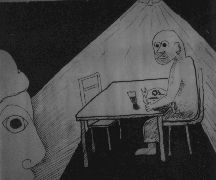
The Meeting (Original Drawing)
The original drawing of 'The Meeting' was made after having a dream that concerned my entering a restaurant and seeing a man sitting alone at a table. When given the drawing, someone told a story of an artist at work in his studio. Hearing the story, I was surprised to have the man labeled an artist - a placement on my scale of desirability just the opposite of how I had regarded the man in the dream. How could he be seen as an artist? What was I missing? Was it possible that by rejecting the scruffy and seemingly inept parts of myself I was turning away the opportunity to explore and develop my creative talents? My friend's story forced a re-evaluation of my dream, of that man and of my attitudes.
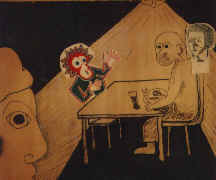
The Meeting (amended, after The Dream Story Game)
For
one thing, I decided to suspend my usual judgment of my doodles, designs and
cartoons as awkward and inept, and allowed them to have more free rein in the
expression of my feelings and intuitions. I treated this process with more
respect and also invested in some art supplies. Without this dream, and its
interpretation, I doubt if I ever would have become so dedicated in practicing
artwork.
Drawing the story of a dream, turning a dream into a picture, is only one way to incorporate dreams into the subject matter of artwork. Simply the mood of a dream can instigate a painting. What two or three colors express the feeling in the dream? Would this color be big or small, pointy or rounded, concentrated or diffuse? How do the other colors fit in? Here we have the beginning of an abstract expression.
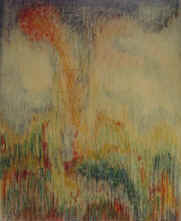
Feeling in a Dream
Making
an abstract expression is a good way to get in touch with one's moods and to
discover the meaning of them. It doesn't have to be with marks on paper,
however, as nonsense noises, for example, that express the mood can evolve into
a song, or movements can evolve into a dance. The mood of a dream, or the
feeling residual, can be the most lasting effect of a dream. Such a feeling can
be difficult to put into words, and we are its captive until we can find some
way to give expression to it that allows us to realize its meaning. We can use
painting, singing, dance, even poetry, to get in touch with the feeling and, if
we come up with a finished product that communicates a meaningful feeling to
others, perhaps we have gone another step in the direction of art.
To supply the content for art, we
don't have to use all the dream. A single dimension may suffice. It could be
the mood. Sometimes a single image or symbol from a dream can be elaborated in a
meaningful and powerful manner. That's what I've done in my painting,
'Flowering.' It is one image from one of my gardening dreams. In a course on
'Haiku Dream Realization,' I demonstrated the use of poetry for dream symbol
elaboration by writing a Haiku poem about this flower, calling it a 'Mouse
Flower,' to express its shy, but magical, qualities. There were no white dots
in the dream, but in the painting, the white 'twinklies' are a magical
contrast to the flower's rather awkward lines of opening. I am still shy about
my Mouse Flower; yet I did exhibit this painting and show it here to you.
Just as you don't have to use all
of dream, so also do you not need to restrict yourself to a single dream, but
may draw from many all at once. In my course on 'Dream Shields,' I present a
simple way of combining dream symbols from many different dreams to create a
visual statement. A dream shield can be a mandala design using dream symbols as
the content. A mandala is usually a statement about the self, but one can
combine dream symbols - one's own symbolic vocabulary - to create statements
about most anything. Linking dreams together in this way, with an implicit story
line or theme, is the beginning of thinking mythically - explaining or answering
a question by telling a story composed of symbols from the unconscious. Perhaps
such an approach produces an allegorical painting. Think of the juxtaposition of
symbols in Magritte's paintings, or the boxed assemblages of Joseph Church.
I have also been concerned with the
spiritual essence of art, having to do with the creative force, and helping
people awaken to its presence in their lives. A spokesman for this point of view
might be Frederick Franck, with his book, Art as a Way: A Return to the
Spiritual Roots. I also hearken back to the ancient Aztec tradition of the
artist (toltecatl = 'wise man and artist') as an ideal, much as we might use
the phrase, 'the Christ,' to refer to an ideal, a potential, a pattern, a
truth. In the Aztec tradition, to be an artist was to know God as He manifested
uniquely in that artist's heart and to take all pains necessary to give
truthful, and the most beautiful that the artist was capable of, testimony of
that presence. The third year I was able to test this approach by working with
three artists over an extended period to develop innovations and improvements in
their artwork through the study of their dreams.
The use of dreams to develop
innovations in the art technique excites me because it generalizes to
innovations in other areas of life. What do we know, generally about dreams an
innovations? For the most part, from historical, anecdotal reports, they seem to
come unbidden to a person who has been wrestling hard with a problem, and
usually in very explicit form: in the dream, a solution or innovation is
witnessed. I myself have had dreams that helped me innovate in my profession -
experimental psychology of dreams - and in other areas, too, such as the
watercolor paintings that are shown here - and some dreams of innovations come
unbidden, others were incubated, some were explicit portrayals of the
innovation, others required interpretation. What I have found about trying to
share with others the possibilities for innovation through dreams is that the
creative dreams of historical record - those unbidden and explicit dreams - do
not inspire people, but leave them passive, waiting until the day they might be
given such a dream. It also gives them an unrealistic goal, in that there is the
impression that a creative dream is always distinguishable by its explicit
portrayal of an innovation. Not that I would deny that the most cherished and
valuable dreams may come unbidden and need no interpretation, but I do believe
that it is important to start with what you have and work with it.
How I have worked with selected
artists to help them innovate with their dreams is exactly how I have worked
with anyone who was working on a problem and who was willing to allow dreams to
make a statement about their work: What is your goal? What are the perceived
obstacles to your reaching your goal? What solutions have you tried? In what
ways have these solutions been satisfactory and in what ways have they been
unsatisfactory? What will be the consequences of your achieving your goal? Are
you afraid of any of the consequences? Are there any rules of procedure that you
feel you must abide by in reaching your goal? What assumptions have you made
about the nature of your problem that limit your choice of solutions. The
answers to these sorts of questions help clarify the nature of the challenge the
person has accepted and the meaning it has for the person. I assume that a work
of art, like an invention, reflects the artist or the inventor, that the process
of interaction between the artist and the raw materials reflects the artist as
well as the materials, but that the creator is primary. When I take this
perspective, then dreams become a natural helper, for dreams are meant to clear
a path among the objective realities in life for the person's subjective, but
true, self to come out and contribute to those objective realities. Again,
it's that notion that everyone has a light bulb to contribute to the world,
and dreams are waiting for us to ask for their help in finding and giving birth
to that lightbulb. So let's look at the dreams.
When working with someone on
innovation and dreams, when we first look at the dreams, they seem to have
little to do with the work issue at hand. To a large extent that is because most
people separate their work issues from their personal issues, so all the
feelings, worries, conflicts and other such typical dream contents, although
they clearly relate, when interpreted, to the dreamer's person life, don't
seem to relate to their work issues, which seem to be issues of competence,
pride, ignorance and acclaim. But when their personal issues are seen in a
broader perspective, and when the answers to all the questions concerning the
work goal are considered, it becomes clear that the personal issues and the work
problems are both a part of the same core issues - discovering and risking being
more of yourself.
I remember working with one artist,
a ceramic designer, who was unsatisfied with the textures she was able to obtain
on the bowls she was making. We spent a lot of time talking about what bowls
meant to her; she had her private reasons, which she didn't feel were
particularly relevant, as well as her public, professional rationale. One of her
dreams involved a 'shrimp boat.' Discussion of that dream revealed a worry
that she would 'miss the boat,' a concern she had about her life in general
as well as about her art, a fear that she didn't have what it takes, or had
the 'wrong stuff,' and would get left behind. I had the impression that she
had the 'right stuff,' but was sitting on it because it didn't match what
she thought was expected, what would gain recognition from her 'art
audience.' She was approaching her work left-handed, as it were, since she
kept her better hand behind her back. When we got to talking about shrimp, I
noticed that although she said she didn't like them, she was able to describe
their texture in some detail. It seemed as if she had some energy invested in
the shrimp texture, so I suggested that she explore this texture in her
ceramics. Out of this exploration came a new textural vocabulary which she
developed in her work. As part of this artistic breakthrough came also more
self-acceptance and confidence concerning the value of her own inclinations. The
professional and personal dimensions grew simultaneously.
Several artists have participated in my work with dream incubation. I've included two examples of their dream inspired drawings here, one by Mayan artist Eliezer Canul, and one by James Yax.
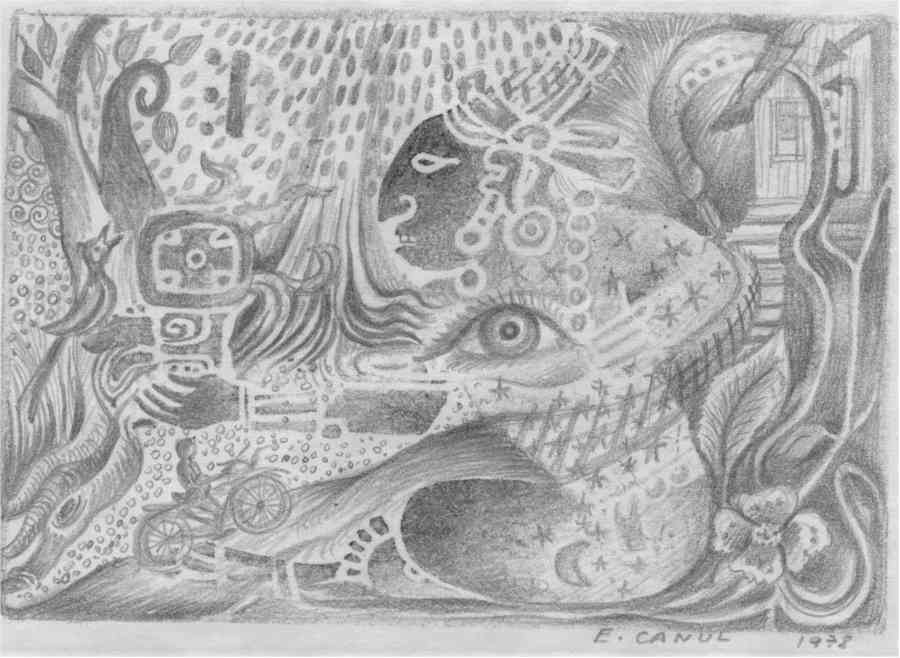
Dream with Henry, by E. Canul
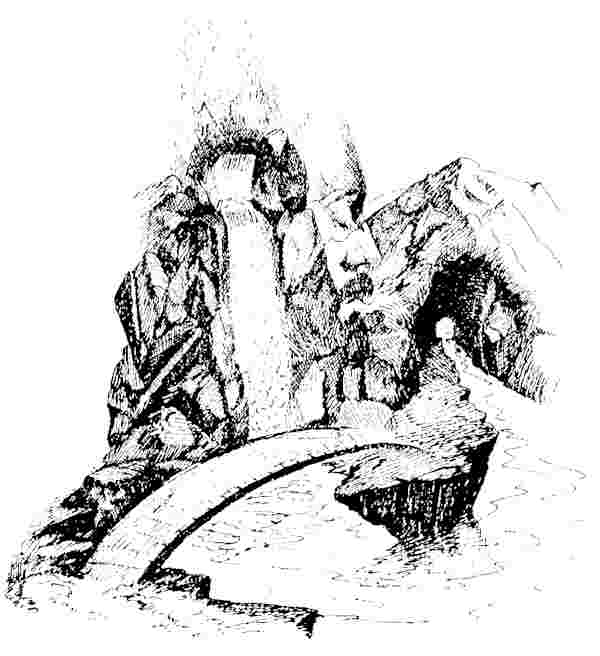
A Dream, by J. Yax
Confidence to be more yourself in
your work - that seems to be the most general result of working with dreams to
enhance creativity - which allows our naturally innovative nature to express
itself. It was that way with my own work.
I had begun by drawing my dreams,
using magic markers for color, doing so primarily to commemorate them and to
allow me to reflect upon them directly. I didn't feel I could 'draw,' as
these dream drawings didn't look anything like my dreams. But they 'felt'
right, and that seems to be what mattered at the time. Then someone gave me a
set of watercolors. I tried them out, found them fun, but difficult to use. I
did what I could with them, rather enjoyed using a brush and a box of colors,
and was fascinated by what happened on the paper. Yet it seemed difficult to
express any intention through the watercolors. But then I had a dream.
I
am in a movie theater looking at a large painting projected on the screen. The
painting is like a large stained glass window, the surface area being divided
into discrete areas, each filled with color. I hear my father's voice telling
me that I can paint like that.
I used this dream as a basis for simplifying my approach to learning watercolors. By taking a piece of paper, drawing a design on it, then filling in the spaces with color, I learned how to apply color to paper in a smooth and even manner. I learned how to mix colors and how adjacent colors affected each other. I also learned how to build up color from several different coats of paint. Although this approach to watercolor painting is somewhat trite, it did enable me to learn some basic skills and gain confidence. It was as if my dream was saying, 'Look, I know you feel overwhelmed by the complexity of watercolors, so why don't you try it this way for awhile?' One of my favorite paintings, 'On the Way,' emerged several years later, from this dream. [Note: I can't yet get this painting onto my web site, but I can show you here another painting in the same style: Daffodils]
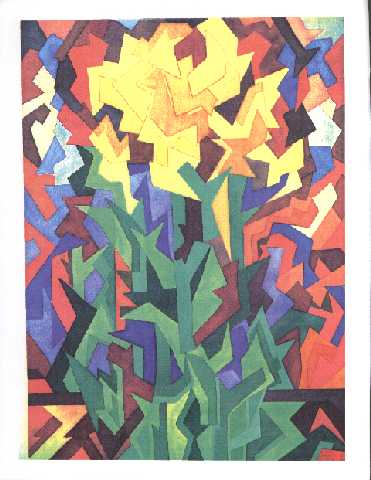
Daffodils
During the time that I was
practicing this approach, I was also attempting to learn how to paint directly
onto the paper. I was watching how my practice in the disciplined approach would
affect my more spontaneous painting. I would fill my brush with color and begin
making marks on paper. I would allow these marks to dry and then fill up with
another color and make more marks, on top of the previous ones at times. I was
concentrating on watching the various colors build up and interact and had
learned how to paint on top of paint without getting 'mud.' I had another
dream.
I am painting under the supervision of a dream teacher. I am making marks on paper in a rather spontaneous manner. When I am finished, my teacher asks me to examine the painting to see what I would see. I notice a figure implicit in the random marks, much the same way I might see something in an ink blot, and experience a strong emotional reaction to the discovery. My teacher says that when I encounter such an emotional reaction, I'll know I've found something.
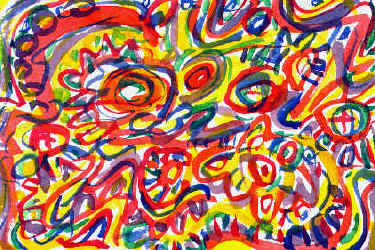
Discovery
This dream encouraged me to pursue painting in the manner I had been exploring. The importance of feeling was emphasized in the dream, as well as the process of discovery. The dream also marked another breakthrough for me. It suggested that although I didn't feel confident about setting out to paint 'something,' if I would simply put the brush to paper, make little marks, focus on the sensory effects of the color, then something would probably emerge from these marks that would give me a definite feeling of recognition. I used this method of painting for several years, primarily as a psychological tool. If I was in a mood and wanted to explore it, I would paint marks on paper until I felt finished, examine the result until some figure emerged that spoke to my mood. I also found that this approach was a good one for painting in the mood of a dream, and the resulting figures that I responded to would often help me understand the import of the dream. These paintings were quite personal - I called them my 'psychological studies,' and were not suitable for showing to others. Wanting to honor this dream, however, I painted 'Dionysus' using this method [Note: Not able to get this painting onto the web at this time]. As intricate and planned as it looks, I began by some random marks and continued in this manner until a figure appeared, which I then built up in increasing detail using the overlay method I had developed.
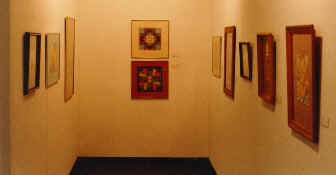
Dream Art Exhibit
When I was asked to be the subject
of a Dream Art Exhibit, I was concerned that somehow exhibiting my work would
jinx my continued enjoyment of painting. Perhaps I was simply nervous and
self-conscious, not thinking of myself as an artist-for-show but instead more an
artist in spirit. For most of the three months I spent preparing for the
exhibit, I had no dreams. I would have been a very frustrating subject for one
of my experiments. But as I was getting more and more of my old paintings
framed, and having a chance to reflect upon how important it has been to me to
have the opportunity to paint, my focus shifted to my message to others: 'Just
as I had lacked confidence in my ability and had been inspired by my dreams, so
can you be inspired by your dreams.' Then, a week before the show, I dreamed
that the exhibit was opening, and that I was outside, painting an invitation to
the show on the sidewalk. I awoke from this dream and immediately painted a
sketch of how I was painting on the sidewalk. Then I was able to complete a
finished painting in that style for the exhibit (not shown here). I was grateful
that my dreams had provided me with something new to work on. Then, on the
morning of the opening, I awoke with another painting on my mind. I painted that
in my dream journal and realized that for me the process of dreaming and
painting would continue as an ongoing exploration. This last dream removed my
doubts and made it possible for me to be present at the opening of my exhibit,
answer questions, and share my delight at the work.
It is difficult for me to form an
evaluation of these paintings in terms of artistic standards. From a
psychological standpoint, I believe I see something of merit in them. I see
something of myself in these paintings, something I like. Some of my friends who
are professional artists say that they value the unique quality with which the
watercolors are imbued, something they say reminds them of what is special about
me to them. It sounds trite in words, and maybe all that is being reflected is
love, or perhaps spirit. At another level, I can see how the paintings reflect
something of my psychology. These paintings are not the flowing, expressionistic
happenings that are often associated with watercolors at their finest. On the
other hand, although there is a precision to the paintings, they did emerge
somewhat spontaneously, like a doodle, and are full of expression. I see the
paintings reflect an integration of a longstanding polarity within me, between
planning and being spontaneous, evidencing an ability to arrive at a dimly
perceived goal through a long process of successive approximations, which is a
combination of both intentionality and chance. Such integrations I value, and
have my dreams to thank for them in many areas of my life.
Getting help from my dreams has
seemed to involve my being open to innovative modes of perception as well as
feeling of greater self-acceptance. Dreams knit together the contradictory and
conflicting aspects of my personality in ways that I could never have invented
myself. As when my first dream slowly taught me the value of the rejected potato
chips and mayonnaise, so later dreams have given me the confidence to let go of
any limited notion of how I 'should' be and discover instead how I actually
am created - in the image of the Maker. Each of us is creative, each in a unique
way. Dreams seem to wan t to help us discover that there is a whole lot more to
us than we ever suspected.
Although they need to be approached
and treated with the respect due a sovereignty, dreams are not really an end in
themselves. Their secret is that they are but a doorway to a more valid and
meaningful perception of life than we normally obtain through our scientific
education. Dreams provide us with an innate, alternative education, and do so
simply by working on our consciousness with stories that affect us at a deep
emotional level. The greatest truths lie within us and come to the surface in
our dreams. We needn't agonize over these dreams, trying to break their code.
There is no code. They are simply stories we need to remember and to bring into
our lives in a variety of natural ways. In that way they can guide us, not only
in our own search for happiness, but also in our efforts to prepare a better
world in these difficult and threatening times. I can think of no other
renewable resource that is as universally available for developing that vital
link to nature's own invisible laws and purposes and to the spirit's
activity within us than getting help from our dreams.
Note:
To see a summary of this essay in pictorial form,
showing the progression of my
art, see